


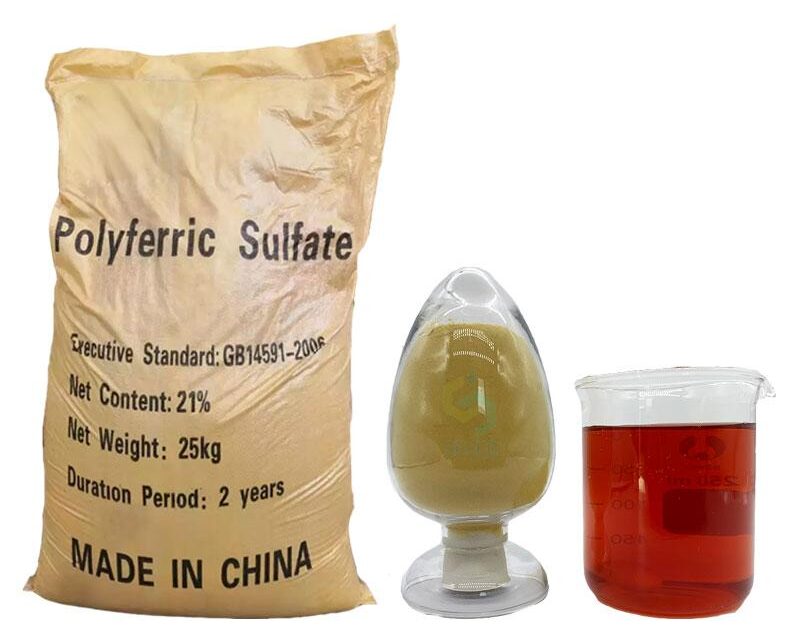
 As a highly efficient inorganic polymer flocculant, Polyferric Sulfate (PFS) plays a vital role in water treatment. Its mechanism of action encompasses multiple dimensions, delivering outstanding water purification results through synergistic effects.
1. Hydrolysis
When PFS comes into contact with water, the iron ions (Fe³⁺) in its structure rapidly react with water molecules. This hydrolysis process promotes the formation of hydroxyl ions (OH⁻) and hydrated iron ions. These products exhibit high chemical activity and can interact with various pollutants in water—such as dissolved colloidal particles—altering their surface properties and paving the way for further purification.
2. Oxidation
PFS also acts as an effective oxidizing agent. It undergoes redox reactions with certain organic and inorganic substances in water, converting soluble pollutants into insoluble precipitates. For example, it can oxidize reducing organic contaminants, transforming them from a soluble state into solid forms that can be easily separated from the water.
3. Adsorption
Thanks to its porous structure and high surface activity, PFS possesses strong adsorption capabilities. Its numerous active sites act like “traps,” effectively capturing pollutants such as organic dyes and heavy metal ions (e.g., lead, mercury). This makes PFS particularly effective in treating industrial wastewater containing complex contaminants.
4. Sedimentation
The final step in the PFS purification process is sedimentation. The products formed through hydrolysis and oxidation aggregate into dense, stable precipitates that settle quickly. During settling, these precipitates collide and combine with suspended solids in the water—much like a snowball effect—carrying away a wide range of impurities and leaving behind clarified water.
Through the combined actions of hydrolysis, oxidation, adsorption, and sedimentation, PFS efficiently removes diverse pollutants from water. It is widely used in applications such as drinking water treatment, industrial wastewater purification, and municipal sewage management, providing a reliable solution for improving water quality worldwide.



contact us send message