

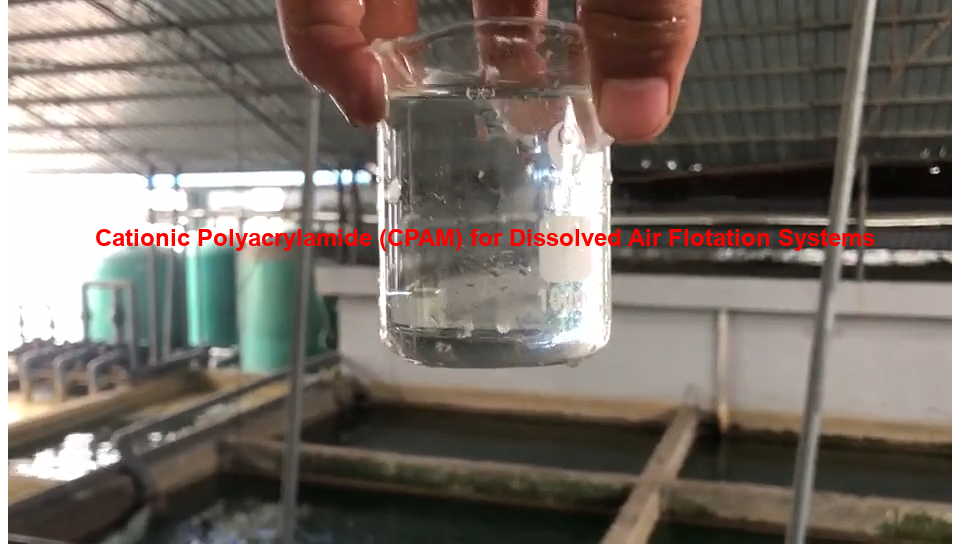
Cationic Polyacrylamide (CPAM) for Dissolved Air Flotation Systems
Cationic Polyacrylamide (CPAM) is a high-efficiency polymer widely used in Dissolved Air Flotation (DAF) systems for industrial and municipal wastewater treatment. In flotation processes, CPAM plays a critical role in floc formation, charge neutralization, and micro-bubble attachment, directly determining flotation speed, sludge stability, and effluent quality.
Why Use Cationic Polyacrylamide in DAF Systems?
Most suspended solids, emulsified oils, and organic colloids in wastewater carry negative surface charges. CPAM, with its cationic functional groups, neutralizes these charges and forms strong polymer bridges between particles, creating large and stable flocs.
- Improves floc size and strength
- Enhances micro-bubble adhesion
- Accelerates flotation speed
- Forms thicker and more concentrated float sludge
- Reduces SS, COD, and oil content in effluent
Key Effects of CPAM in Dissolved Air Flotation
| Performance Aspect | Effect in DAF System |
|---|---|
| Charge Neutralization | Eliminates electrostatic repulsion between particles |
| Flocculation Bridging | Forms large and compact flocs suitable for flotation |
| Bubble Adhesion | Improves attachment between flocs and micro air bubbles |
| Flotation Stability | Prevents floc breakage and sludge dispersion |
| Overall Treatment Efficiency | Higher removal rate of SS, oil, and organic matter |
Technical Specifications of CPAM for DAF
| Item | Specification |
|---|---|
| Product Type | Cationic Polyacrylamide (CPAM) |
| Appearance | White Granular Powder |
| Ionic Degree | 5% – 60% (Customized) |
| Molecular Weight | 8 – 12 Million |
| Solid Content | ≥ 90% |
| Recommended Solution | 0.1% – 0.3% |
| pH Range | 4 – 9 |
CPAM Ionic Degree Selection for Flotation Applications
Choosing the correct ionic degree is essential for optimal flotation performance. Below is a practical comparison for DAF applications:
| Ionic Degree | Typical Wastewater | Floc Characteristics | Flotation Performance |
|---|---|---|---|
| 5–10% | Municipal wastewater | Soft flocs | Standard flotation |
| 10–20% | Food processing, papermaking | Larger, stable flocs | Good flotation |
| 20–30% | Oily wastewater, slaughterhouse | Dense flocs | Fast flotation |
| 30–40% | High oil & organic wastewater | Compact, strong flocs | Excellent flotation |
| 40–60% | Emulsified oil wastewater | Rapid charge neutralization | High-efficiency flotation |
Recommended Application Process
- Pre-treatment with PAC or PFS for destabilization
- CPAM dosing after rapid mixing zone
- Gentle mixing to avoid floc breakage
- DAF unit flotation and sludge removal
How to Select the Right CPAM for Your DAF System
- Identify whether wastewater is oil-rich or organic-rich
- Confirm existing coagulant usage (PAC / PFS)
- Evaluate floc size and flotation stability
- Conduct jar tests to confirm dosage and ionic degree
Common Problems & Troubleshooting (FAQ)
Q1: Why is flotation sludge loose and unstable?
Possible reasons include low ionic degree, insufficient PAC dosage, or excessive mixing intensity.
Q2: Why do flocs break easily?
Excessively high molecular weight or strong shear force can destroy floc structure.
Q3: Does higher CPAM dosage mean better flotation?
No. Overdosing may cause charge reversal and poor flotation efficiency.
Q4: Can CPAM be used alone in DAF systems?
In most cases, CPAM works best in combination with inorganic coagulants such as PAC or PFS.
Q5: Is CPAM for flotation the same as CPAM for sludge dewatering?
No. Flotation-grade CPAM requires different ionic degree and molecular design compared to dewatering-grade CPAM.
Conclusion
Cationic Polyacrylamide is a key chemical in dissolved air flotation systems. Proper selection of ionic degree and dosage significantly improves flotation efficiency, reduces operating costs, and ensures stable wastewater treatment performance.
Contact us for customized CPAM solutions and free selection guidance for your DAF system.



contact us send message