


 In industrial production processes, fluoride-containing wastewater has become a significant source of pollution. This type of wastewater mainly originates from industries such as aluminum electrolysis, steel, glass, semiconductors, and pharmaceuticals, and its most notable characteristic is a high concentration of fluoride ions. If this fluoride-containing wastewater is allowed to be discharged directly into the environment without treatment, it will lead to a series of serious consequences. In terms of human health, long-term consumption of water with excessive fluoride levels can damage bones and teeth, leading to diseases such as dental fluorosis and skeletal fluorosis. More worryingly, it may also increase the risk of blood diseases, enteritis, and even cancer. For the ecological environment, high-fluoride wastewater can damage soil structure, pollute water bodies, and affect the normal growth and survival of plants and animals.
Currently, various methods are widely used for fluoride removal from sewage and industrial wastewater, including precipitation, chemical precipitation, adsorption, coagulation sedimentation, reverse osmosis, ion exchange, and electrolysis. However, these methods each have their advantages and disadvantages, with varying degrees of problems in cost control, defluoridation efficiency, process complexity, and equipment replacement frequency. For example, precipitation methods are relatively inexpensive, but their defluoridation efficiency may be less than ideal, making it difficult to meet increasingly stringent emission standards; reverse osmosis methods have good defluoridation efficiency, but require large equipment investments, high operating costs, and demanding maintenance requirements.
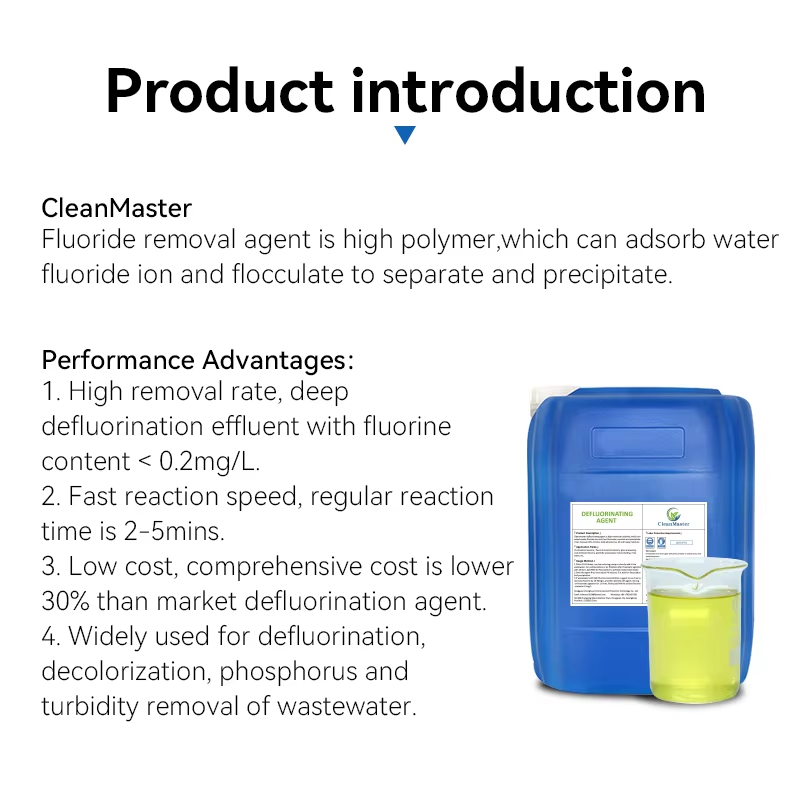
Against this backdrop, defluoridating agents have emerged as a powerful tool for the advanced treatment of fluoride-containing wastewater. Defluoridating agents are chemical agents specifically developed to remove fluoride ions from water. They have demonstrated outstanding performance in the treatment of excessive fluoride in wastewater from various industries, playing a crucial role, especially in advanced treatment stages, ensuring that the effluent fluoride ion concentration consistently meets standards, below 1 mg/L.
The advantages of defluoridating agents are significant. First, in terms of removal rate, through careful optimization of formulation and process, their defluoridation capacity is powerful. Taking some highly efficient defluoridating agents as an example, they can significantly reduce the concentration of fluoride ions from tens of milligrams per liter to below 1.0 mg/L, and some can even reach below 0.5 mg/L, achieving deep defluoridation. Secondly, they have a wide pH range of applicability. Compound defluoridating agents and new high-efficiency defluoridating agents can function normally within a wide pH range. This means that in practical applications, there is no need to spend a lot of effort and cost strictly adjusting the pH of wastewater, greatly simplifying the operation process. Furthermore, defluoridating agents have good adaptability to various water qualities. Whether it is high-concentration fluoride wastewater, low-concentration fluoride wastewater, or even deep defluoridation of drinking water with high water quality requirements, they can handle it with ease. In addition, safety is also a major highlight of defluoridating agents. Most defluoridating agents, such as activated carbon and activated alumina, are non-toxic and harmless, and will not cause secondary harm to human health and the environment while effectively removing fluoride ions.
In summary, defluorinating agents, with their outstanding characteristics of high efficiency, low cost, ease of operation, and environmental friendliness, have shown broad application prospects in industrial, municipal, and drinking water treatment fields, providing a reliable and effective solution for the treatment of fluoride-containing wastewater and helping environmental protection to reach new heights.



contact us send message