

When treating highly alkaline wastewater, it’s necessary to choose agents that maintain stability and flocculation efficiency in high pH environments. The following types are suitable:
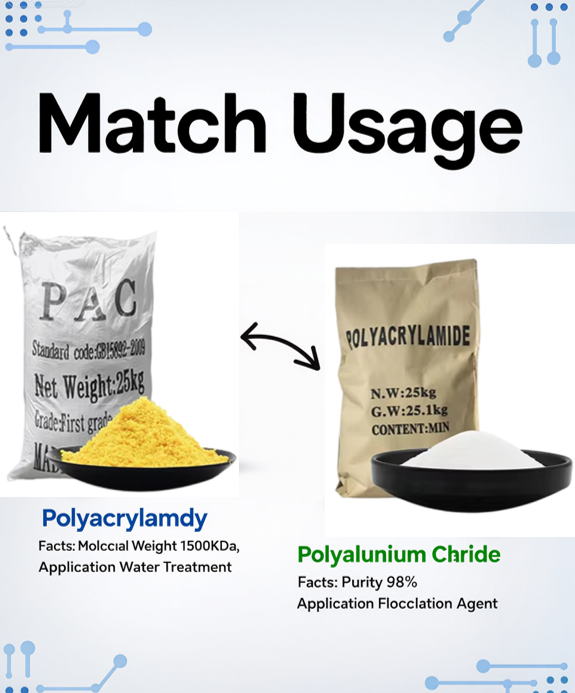
Cationic polyacrylamide (PAM): Performs excellently over a wide pH range (including strongly alkaline conditions). It adsorbs negatively charged wastewater particles through charge neutralization, promoting flocculation and sedimentation. It has wide applicability and high efficiency.
Polyaluminum chloride (PAC): Although commonly used in neutral or slightly acidic environments, it can be adapted to alkaline wastewater with appropriate adjustments (such as using pH adjusters). It has strong charge neutralization capabilities, forming large flocs that settle quickly, making it suitable for treating alkaline wastewater with high suspended solids content.
Ferric salt flocculants: Such as ferric chloride and ferrous sulfate, they easily form hydroxide colloids under alkaline conditions, exhibiting outstanding removal effects on pollutants such as phosphorus and heavy metals. However, it should be noted that iron salts may slightly discolor the water; selection should be based on effluent requirements.
Natural/Bio-flocculating agents: Environmentally friendly agents such as chitosan and starch derivatives exhibit good stability in alkaline environments, making them suitable for scenarios with high environmental requirements without introducing secondary pollution.
In practical applications, single agents or combinations can be selected based on the type of pollutants in the wastewater (such as suspended solids, colloids, and specific ions) and the required water quality after treatment to optimize flocculation effects.



contact us send message